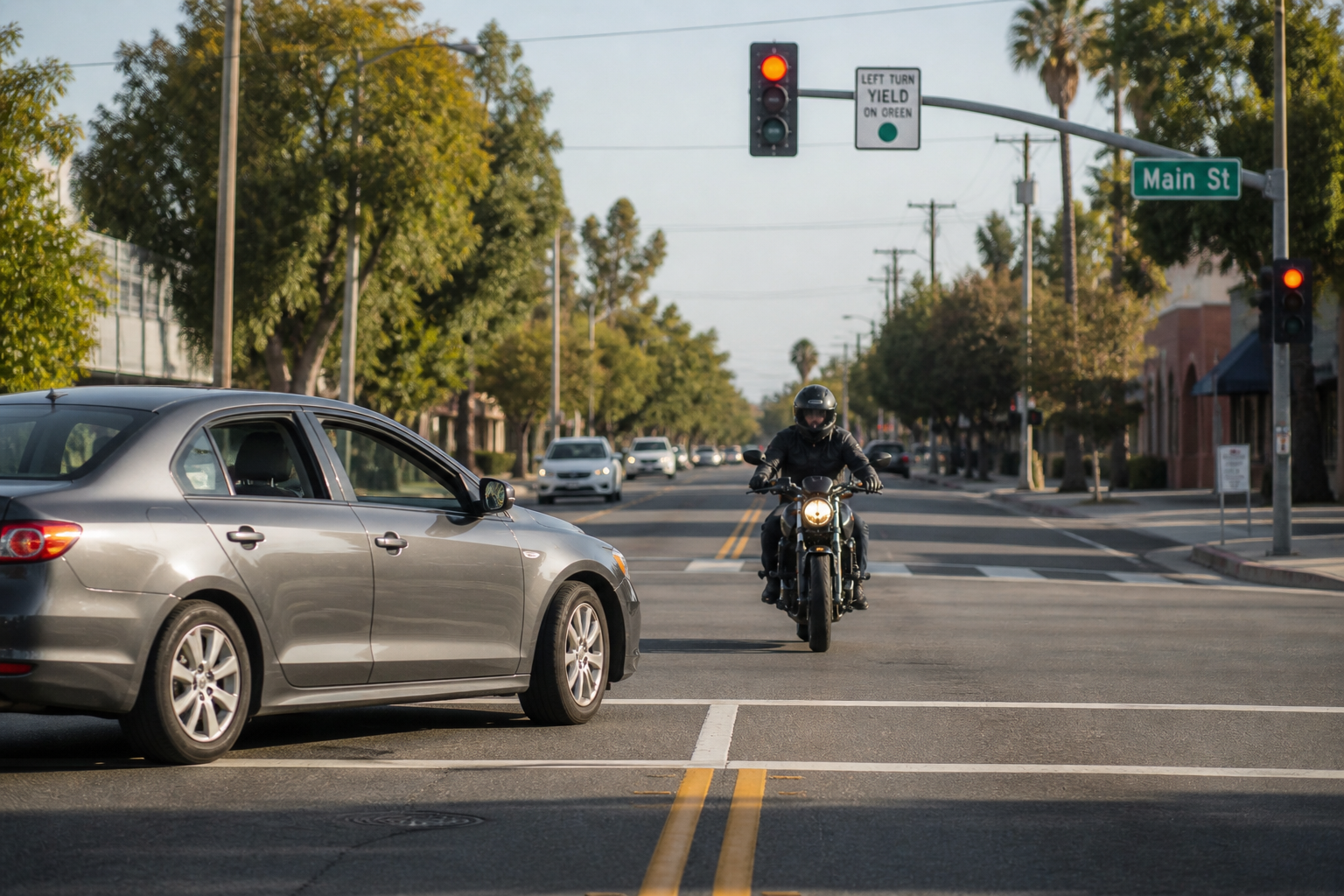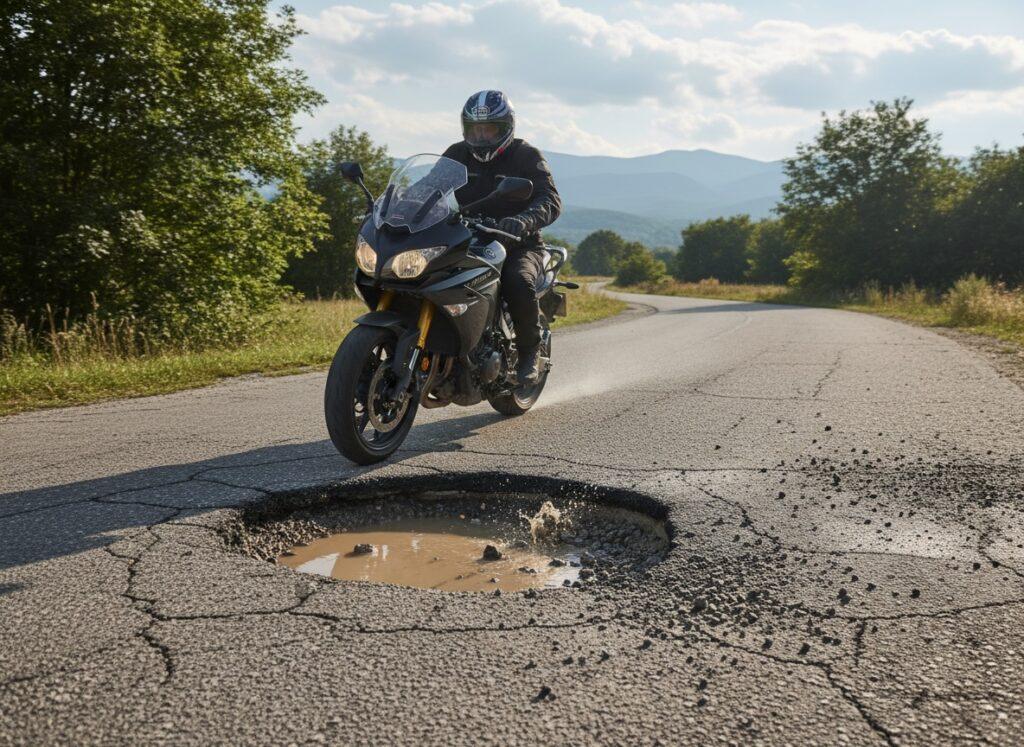
Motorcycle accidents caused by potholes can result in serious injuries, expensive repairs, and complicated questions about liability. Unlike passenger vehicles, motorcycles rely on two wheels for balance and stability. When a rider encounters a deep pothole, broken pavement, or an uneven road surface, even a momentary loss of control can lead to a devastating crash.
In San Bernardino and throughout California, motorcyclists travel on highways, residential streets, mountain roads, and busy urban routes. Road conditions can vary considerably, and unexpected pavement defects may create dangerous situations for riders.
When a pothole contributes to a motorcycle accident, determining responsibility is not always straightforward. Depending on the circumstances, a government agency, contractor, or another party may be legally responsible. However, proving liability requires more than showing that a pothole existed.
This article explains how pothole-related motorcycle accidents happen, who may be liable, what evidence matters, and how California law affects claims involving dangerous roadway conditions.
Why Potholes Are Dangerous for Motorcyclists
 Potholes develop when pavement deteriorates because of traffic, water infiltration, temperature changes, and repeated stress. As cracks expand and sections of asphalt break apart, depressions form in the roadway. Some are shallow, while others are deep enough to damage tires, wheels, and suspension components.
For motorcycles, these defects can be especially hazardous. A motorcycle has a smaller contact area with the pavement than a typical passenger vehicle. Striking a pothole can disturb the rider’s balance, change the motorcycle’s direction, or cause sudden instability.
Several problems may occur when a motorcycle encounters damaged pavement:
- Loss of traction: Loose gravel and broken asphalt can reduce tire grip.
- Wheel damage: A deep pothole may bend a rim or damage a tire.
- Sudden steering changes: The impact may cause the handlebars to move unexpectedly.
- Loss of balance: A rider may struggle to keep the motorcycle upright after striking a defect.
- Secondary collisions: A motorcycle that becomes unstable may enter another lane or strike a nearby vehicle.
These hazards are particularly concerning when riders have limited space to maneuver. Heavy traffic, poor lighting, or an obstructed view can make a dangerous pothole difficult to identify before reaching it.
For additional information about riding conditions, read our guide to the most dangerous roads for motorcyclists in San Bernardino.
Common Causes of Pothole-Related Motorcycle Crashes
Not every pothole accident happens in the same way. Some crashes occur when a motorcycle directly strikes damaged pavement. Others happen when a rider attempts to avoid an obstacle and loses control.
Direct Impact With a Deep Pothole
A motorcycle may experience a sudden jolt when its front wheel enters a pothole. Depending on the defect’s size, the motorcycle’s speed, and the rider’s response, the impact may damage the wheel or interfere with steering.
Sudden Swerving to Avoid Road Damage
Sometimes a rider notices a pothole at the last moment and attempts to steer around it. If another vehicle is nearby, the evasive movement may create a collision risk. Investigators may examine whether the rider had sufficient warning and a reasonable opportunity to avoid the hazard.
Loose Gravel Around Damaged Pavement
Broken asphalt and loose stones may collect around potholes. These materials can reduce traction, particularly when a rider brakes or turns. Rainwater may also conceal the true depth of a pothole.
The California DMV Motorcycle Handbook provides guidance on motorcycle operation, road hazards, and defensive riding techniques.
Who May Be Liable for a Pothole Motorcycle Accident?
Liability depends on who controlled the roadway, whether the condition was legally dangerous, and whether the responsible party had sufficient notice and opportunity to address it.
In California, public entities may face liability for injuries caused by dangerous conditions of public property when the statutory requirements are satisfied. These cases are governed by specific rules and exceptions.
State Government and Caltrans
The California Department of Transportation, commonly known as Caltrans, manages the state highway system. If a motorcycle accident occurs because of a dangerous condition on a state-controlled roadway, Caltrans may be a potential responsible party.
However, responsibility is not automatic. The injured rider generally must establish the applicable legal elements, including a dangerous condition, causation, and the required basis for public-entity liability.
Caltrans explains that successful roadway damage claims require evidence of the dangerous condition and the agency’s actual or constructive notice, where that notice is legally required. More information is available in the agency’s statement regarding pothole and damage claims.
City or County Government
If the accident occurs on a road controlled by a city or county, that local government may be responsible for maintaining the relevant roadway.
For example, a pothole on a municipal street may involve a different public agency than a defect on a state highway. Identifying the correct entity is essential because government claims must generally be presented to the appropriate agency.
Private Contractors and Construction Companies
Private parties may also contribute to dangerous road conditions. A contractor performing roadway repairs might leave an excavation improperly protected, fail to restore pavement safely, or create a hazardous transition between road surfaces.
Depending on the facts, a contractor’s negligent work may support a separate liability claim. Investigators may examine construction records, contracts, inspection reports, and whether the contractor followed applicable safety requirements.
What Must Be Proven in a Dangerous Road Condition Claim?
Establishing liability against a public entity generally requires evidence supporting several legal elements. Under California Government Code Section 835, a claimant must show that the property was in a dangerous condition at the time of the injury, that the condition proximately caused the injury, and that it created a reasonably foreseeable risk of the kind of injury that occurred.
The claimant must also establish one of the statute’s additional grounds for liability, such as negligent creation of the condition by a public employee acting within the scope of employment or sufficient notice of the condition under the applicable law.
Important questions may include:
- Was the pothole dangerous when the accident occurred?
- Did the pothole contribute to the motorcycle crash?
- Who owned or controlled the roadway?
- Was the defect created by government work or negligence?
- Did the responsible agency know, or should it reasonably have known, about the hazard?
- Was there sufficient time to take appropriate protective measures?
A pothole’s existence alone does not establish liability. Its dimensions, location, visibility, history, and relationship to the crash may all matter.
Our article on how to prove fault in a San Bernardino motorcycle accident case explains additional evidence and liability concepts.
Evidence Needed to Prove a Pothole Accident Claim
 Evidence can be especially important because road defects may be repaired shortly after an accident. If the pothole is filled or the pavement is resurfaced, the original condition may become difficult to examine.
When it is safe and practical, useful evidence may include:
- Photographs: Images showing the pothole, surrounding pavement, and nearby traffic features.
- Measurements: The defect’s approximate depth, width, and length, documented without entering unsafe traffic areas.
- Crash photographs: Images of the motorcycle, damaged components, debris, and final resting position.
- Witness information: Statements from people who saw the crash or knew about the road defect.
- Maintenance records: Documents showing inspections, repair requests, or previous complaints.
- Medical records: Documentation connecting the accident with the rider’s injuries.
- Video footage: Available recordings from nearby businesses, vehicles, or surveillance systems.
Earlier complaints about the same pothole may be particularly relevant when evaluating whether an agency had notice. However, the significance of those complaints depends on their content, timing, and relationship to the hazard.
Accident reconstruction specialists may also examine the motorcycle’s damage, the roadway defect, and the sequence of events to assess how the crash occurred.
How California Government Claim Deadlines Work
One of the most important differences between ordinary motorcycle accident claims and claims against public entities is the administrative filing requirement.
Under California’s Government Claims Act, a person generally must present a claim to the appropriate government agency before filing a lawsuit for money damages. For personal injury or personal property damage claims, the administrative claim deadline is generally six months from the date the claim accrues.
There are exceptions and additional procedural rules, so riders should not assume that the ordinary personal injury lawsuit deadline applies.
The California Courts Self-Help Guide explains government claim requirements, filing deadlines, and what may happen after an agency responds.
Where Should a Claim Be Filed?
The appropriate filing destination depends on the agency involved and the amount and type of claim.
For certain claims involving Caltrans, the department provides a process for claims of $12,500 or less. Claims exceeding that amount generally go through the state’s Government Claims Program.
Caltrans maintains official instructions on its damage claim submission page, including information for District 8, which covers San Bernardino and Riverside counties.
The California Department of General Services also provides information about presenting claims to the state.
Filing a claim does not guarantee compensation. The agency may investigate, accept, reject, or deny the claim based on the evidence and applicable law.
Can a Motorcyclist Share Responsibility for the Accident?
California follows a pure comparative fault system. This means an injured rider’s recovery may be reduced by their percentage of responsibility for the accident.
For example, a public entity might be found responsible for a dangerous pothole while a motorcyclist is also found partly responsible for traveling too fast for the circumstances.
If recoverable damages total $100,000 and the rider is assigned 20% of the fault, the rider’s recovery would generally be reduced to $80,000, assuming no other applicable limitation changes the result.
Investigators may examine the rider’s speed, attention, available stopping distance, motorcycle condition, and whether the pothole was reasonably avoidable.
However, a rider does not automatically become negligent simply because they were unable to avoid a dangerous road defect. The specific circumstances matter.
What Compensation May Be Available?
When a pothole-related motorcycle accident causes injuries and a legally responsible party can be identified, recoverable damages may include several types of losses.
- Emergency medical treatment and hospitalization.
- Follow-up care, physical therapy, and rehabilitation.
- Lost wages during recovery.
- Reduced future earning capacity.
- Motorcycle repair or replacement expenses.
- Pain, suffering, and other qualifying noneconomic losses.
The available damages depend on the claim, the injuries, applicable law, and any statutory limitations or immunities. Government claims may involve restrictions that do not apply in the same way to ordinary private-party lawsuits.
For a broader explanation of damages, see our guide to motorcycle accident claims and compensation in California.
What Should Riders Do After a Pothole Accident?
After a motorcycle accident involving damaged pavement, the first priority is personal safety and medical care.
If injuries are suspected, call emergency services and avoid unnecessary movement when a serious neck, back, or head injury may be present.
Once the immediate danger has passed, riders can take several practical steps:
- Report the accident: Contact the appropriate law enforcement agency when necessary.
- Seek medical attention: Obtain an evaluation and follow recommended treatment.
- Document the roadway: Photograph the pothole from a safe location.
- Preserve motorcycle evidence: Keep damaged parts when practical and avoid unnecessary repairs before documentation.
- Identify the responsible agency: Determine whether the road is controlled by the state, county, city, or another entity.
- Keep expense records: Save medical bills, repair estimates, receipts, and wage documentation.
- Review filing deadlines: Government claims may require action much sooner than ordinary injury lawsuits.
Insurance coverage may also be relevant. Depending on the policy, collision coverage or medical payments coverage may help address certain losses while liability is being investigated.
Our article on understanding insurance claims after a motorcycle accident provides additional information.
How Motorcyclists Can Reduce Pothole Accident Risks
Although riders cannot control roadway maintenance, they can take precautions to reduce their exposure to hazards.
Scanning the roadway ahead is particularly important. Maintaining a safe following distance may provide more time to identify damaged pavement before reaching it.
Riders should also keep their tires properly inflated, inspect suspension components, and adjust speed to road conditions. Extra caution is appropriate when riding through construction areas, unfamiliar streets, or poorly illuminated roads.
Avoiding sudden steering or braking movements may help preserve stability, although the safest response depends on the motorcycle, speed, available space, and hazard.
The National Highway Traffic Safety Administration offers additional motorcycle safety guidance, including information about protective equipment and rider awareness.
Riders can also review our motorcycle safety tips for San Bernardino riders for broader defensive riding recommendations.
Conclusion
Motorcycle accidents caused by potholes can raise complicated questions about road maintenance, government responsibility, and rider conduct. A dangerous road condition may contribute to a serious crash, but determining legal liability requires examining who controlled the roadway, whether the defect was legally dangerous, and what evidence connects the condition to the injuries.
In California, claims involving public roads may also be subject to special notice requirements, government immunities, and strict administrative deadlines. Understanding these rules is important because missing a required filing deadline can affect the ability to pursue compensation.
Photographs, maintenance records, witness statements, medical documentation, and timely reporting can help clarify the circumstances of a pothole-related motorcycle accident. For riders in San Bernardino, recognizing roadway hazards and understanding how responsibility may be evaluated can support safer riding decisions and more informed next steps after a crash.